
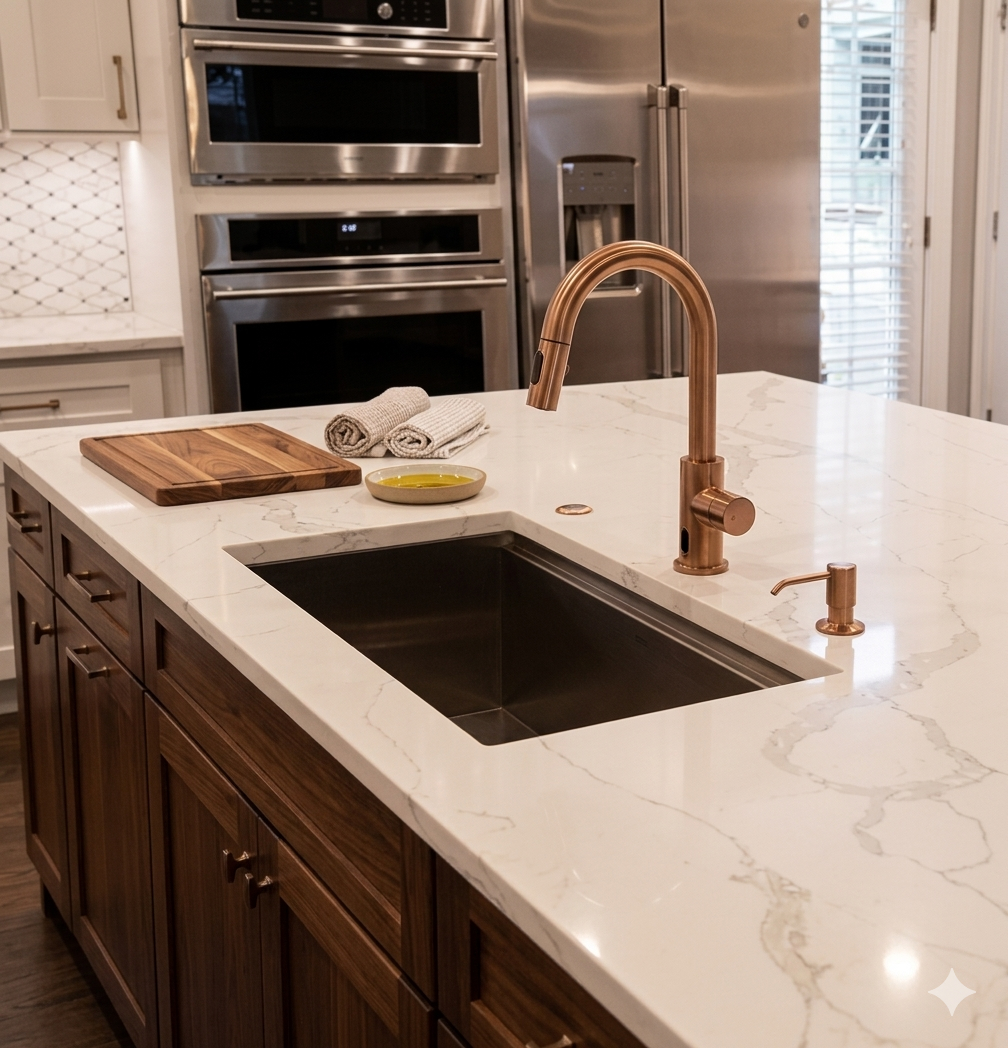
Kitchen surfaces absorb nonstop hits. Heat lands on them. Water sits on them. Weight presses down every day. Over time, weak materials start to show the consequences. They chip, stain, and slowly lose their shape.
Durable materials don’t react like that. They endure pressure without changing form. That is why granite, quartz, quartzite, and solid surfaces dominate durable kitchen design today. They can defy damage from various external factors. So, heat, water, and wear have less impact.
Durability isn’t merely cosmetic. It is vital since durability decides whether the surface survives daily use or falls apart helplessly.
What Are the Materials That Make Kitchen Surfaces the Sturdiest?
Granite, quartz, quartzite countertops, and solid surface options are some apt choices for sturdy kitchen surface design. They naturally handle pressure better than others. Their internal structure helps them stay stable year after year.
Granite kitchen countertop surfaces form under extreme natural pressure. That process is the reason why granite is dense and resistant to heat and wear. Sealed granite stops moisture and holds its strength for years to come.
Quartz kitchen surfaces are engineered from crushed quartz bound together tightly. This makes the surface non-porous. Water doesn’t seep in. Stains don’t settle easily. Quartz maintains its shape and strength even when used in Delaware households without a break.
Quartzite forms when sandstone hardens naturally and becomes an extremely dense stone. This density comes in handy for people looking for durable kitchen countertops. Besides resisting wear and scratches, quartzite holds weight easily and tolerates high levels of temperature without weakening. Even after decades of daily use, the structure of the surface will be sound.
Solid surface countertops are meant to show consistency all the way through. There are no hidden weak spots. Plus, there are no open pores inside. So, moisture can’t penetrate. Plus, the surface never deteriorates unevenly. The uniform structure allows solid surface countertops to remain reliable in the long run. Additionally, there’s strong seam integrity, with fewer chances of weak joints forming easily.
Each one of these materials survives because its structure doesn’t give way readily.
How Do Durable Materials Work to Make Kitchen Surfaces Last Longer?
Strength comes from combating the forces that wear surfaces down:
- Step 1: Dense material stops internal cracking. Pressure stays on the surface rather than weakening the core.
- Step 2: Low porosity blocks water from entering. Or else, moisture can slowly damage the material from the inside.
- Step 3: Hard surfaces resist scratches, heat, and friction. Daily use doesn’t change their structure. Also, the strong internal bonding means less chipping. So, heavy impacts don’t easily break the surface, and long use doesn’t weaken/warp it.
This combination results in a stable kitchen surface that doesn’t degrade with time.
Why Is Durability Important in Custom Kitchen Surfaces?
Kitchen countertops can’t ever escape constant stress. It’s inevitable. Hot cookware gets placed directly on them. Water exposure is a daily affair. And heavy appliances stay in one spot for years.
Materials that can’t handle that pressure begin to fail. Cracks appear, surfaces become weaker, and moisture causes some serious damage. Durable custom kitchen countertops don’t go through that cycle. They stay firm and level. They continue doing their job without needing constant repair or replacement.
Durability protects both function and dependability for a long time.
Benefits of Durable Kitchen Countertops
Durable materials for your kitchen surfaces aren’t gimmicky. At all. They offer a couple of solid perks that low-quality materials can’t replicate:
- Shape Maintained Over Time- Strong materials never lose their form even when stress is high.
- Wear Protection- Tough counters can stand up to nonstop abuse. This means no scratches, no heat damage, and no stress cracks.
- Consistent Surface Performance- Built tough, these surfaces don’t wobble or wear down.
- Fewer Replacements- Solid materials increase lifespan and eliminate weak points.
Go with sturdy materials, and your kitchen surface stays reliable, never fragile.
How to Pick Durable Custom Kitchen Surfaces?
Material strength should drive the decision:
- Dense materials don’t easily wear down, even after years of daily use in a Delaware home. Remember, stable materials only.
- Resisting moisture is mandatory. Quartz countertops and solid surfaces stop water from seeping in and causing damage internally.
- The material chosen must be hard, not easily snappable. Quartzite and granite kitchen surfaces are known for their wear-resisting properties.
- Installation matters. When counters are built and fitted right, they perform at their best right from the start.
Strong custom kitchen surfaces are easy to rely on. Because their structure doesn’t weaken as time passes.
FAQs
Are quartzite countertops and quartz similar?
No. Quartzite is formed in nature. A quartz surface is made with smashed quartz and binders. Both are strong but have different compositions and needs for maintenance.
How long do custom kitchen surfaces last?
If installed properly and basic care is provided, these surfaces stay firm for many years.
How much does a custom kitchen surface cost?
Material, counter size, fabrication, and installation complexity all impact the final cost.